

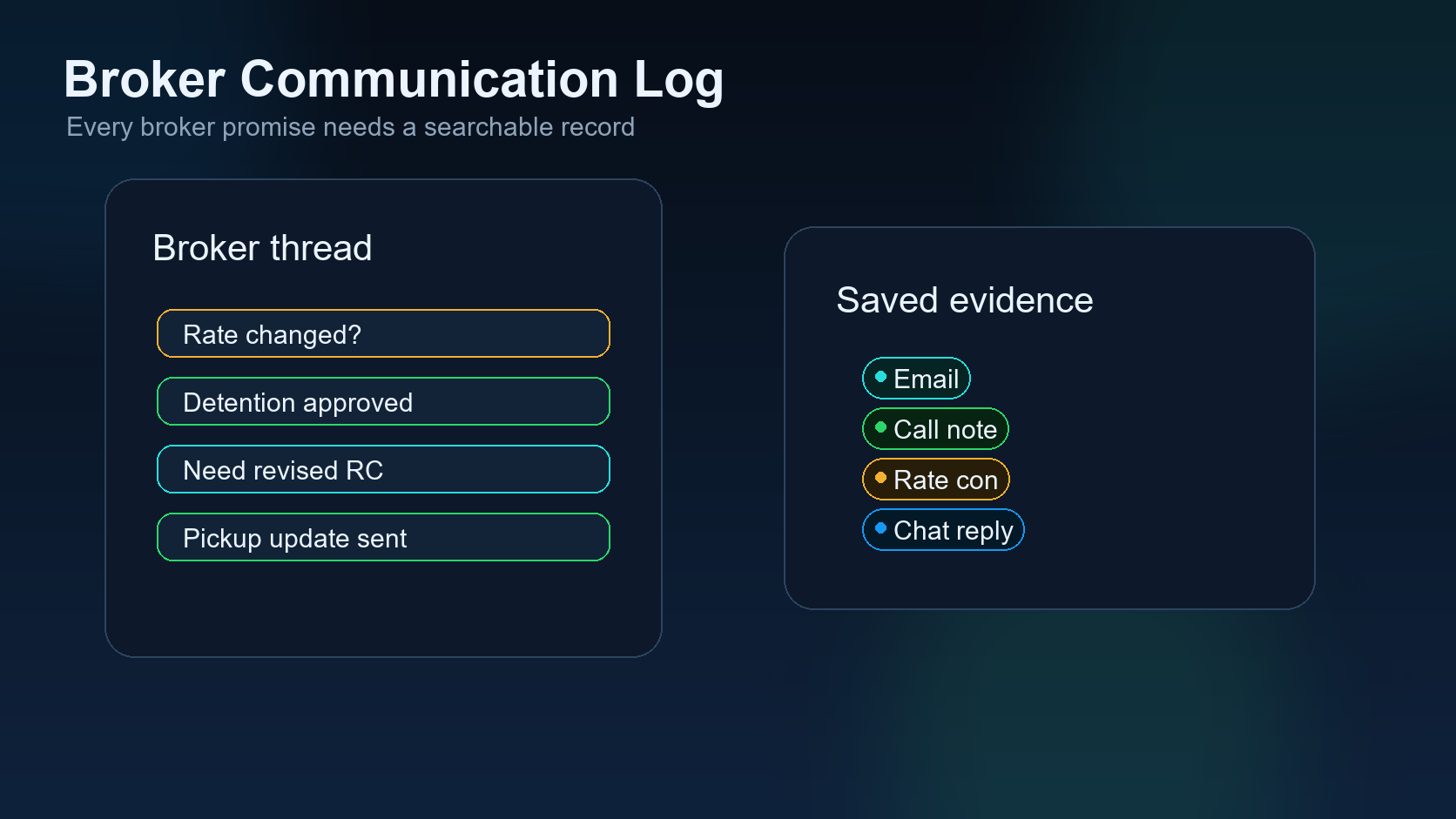
A broker communication log gives a dispatch team one place to see what was agreed, who said it, when it happened, and what follow-up is still open. Without that log, important commitments disappear across phone calls, emails, SMS, WhatsApp, and memory.
This article follows driver document collection in the DIINI Dispatch AI workflow series. Once paperwork and status updates are moving, the team also needs a reliable record of broker conversations. That record protects service, accessorials, and payment.
1. Rate agreement and load terms
The first broker record is the agreement itself: rate, pickup, delivery, equipment, reference numbers, and any special conditions. If the broker later questions a charge or requirement, the dispatcher should not rely on memory.
2. Appointment changes
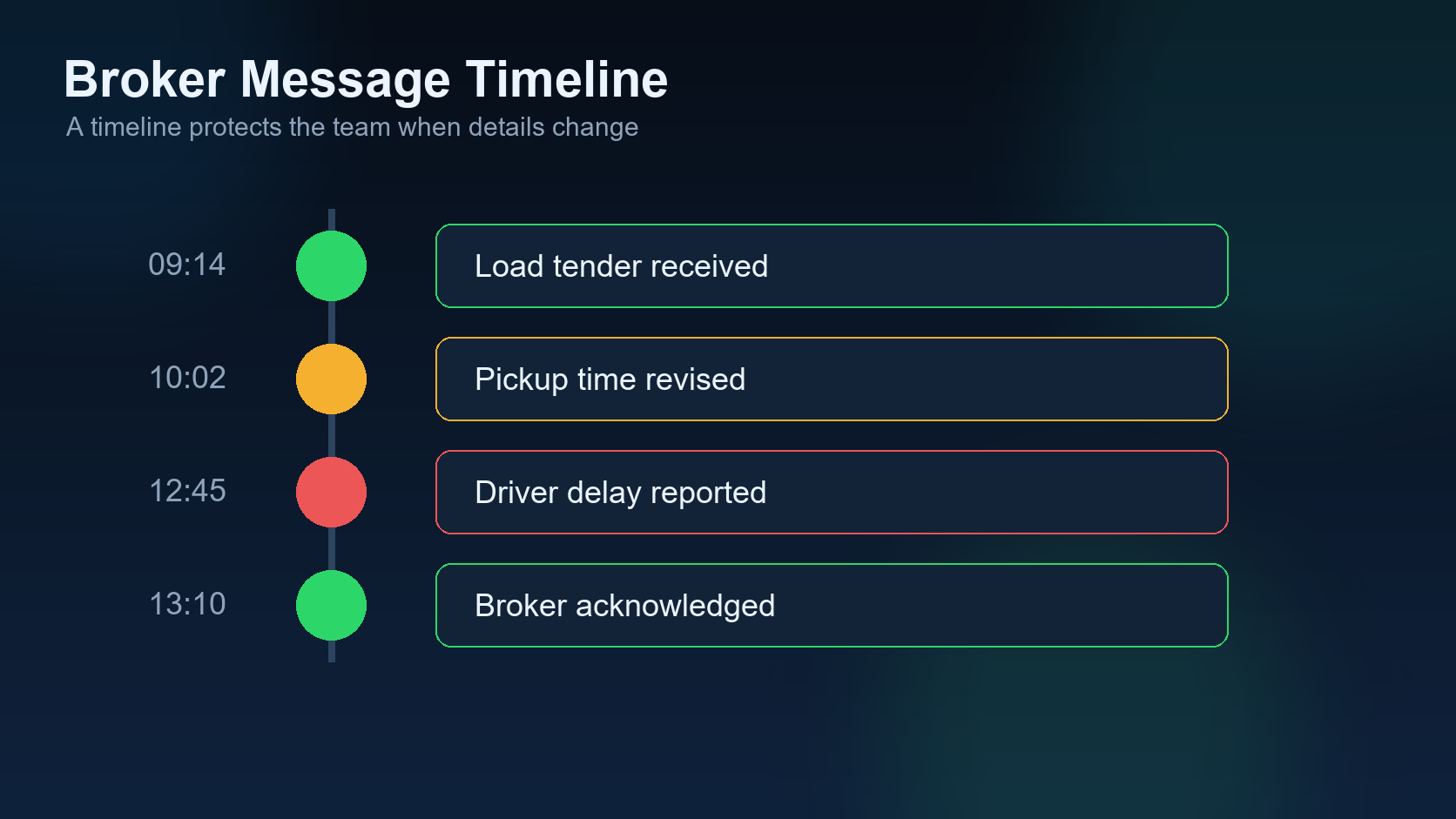
Pickup and delivery appointments often change during a load. Every change should capture the old time, new time, who approved it, and how the driver was updated. This is especially important when late delivery or detention becomes possible.
3. Delay notices
If a dispatcher notifies a broker about traffic, facility delay, driver issue, weather, or breakdown, the log should include the time sent, channel used, broker response, and next follow-up time. Delay communication without a timestamp is weak evidence.
4. Accessorial approvals
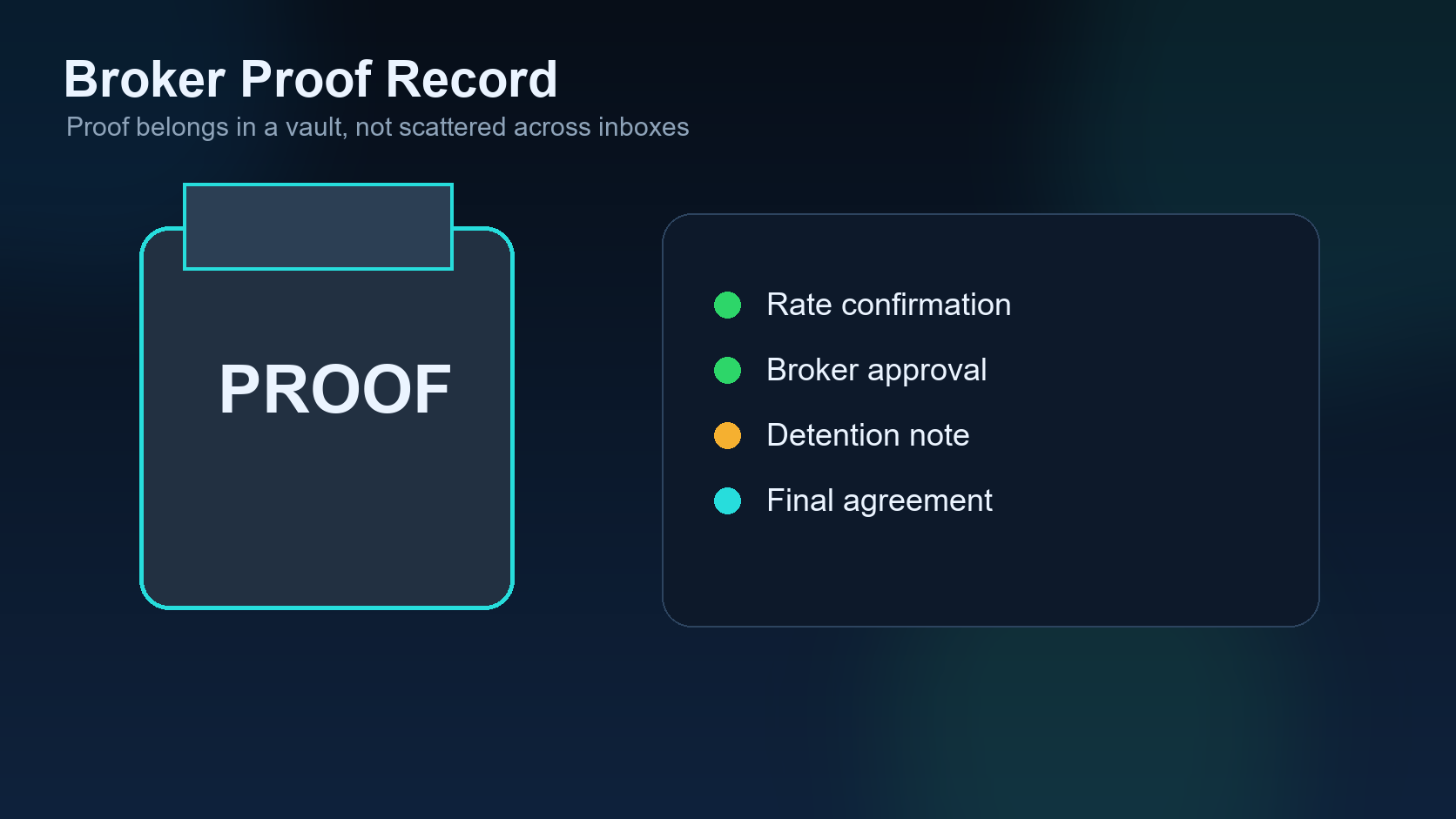
Detention, lumper, layover, extra stop, and TONU discussions should be recorded clearly. If the broker approves an accessorial by email or message, the system should attach that proof to the load.
5. Document requests
When a broker asks for POD, BOL, receipts, photos, or revised invoice details, the request should become a trackable task. Otherwise the dispatcher may believe accounting handled it while accounting believes dispatch handled it.
6. Payment promises and follow-up
Broker payment communication should not live only in accounting notes. If the broker promises payment Friday, asks for a revised invoice, or disputes an item, that record should be visible in the load history.
7. Escalation history
When a problem becomes serious, the team should know which broker contacts were tried, who responded, and what was promised. A clean escalation history makes the operation look professional and prevents repeated calls with no context.
Communication log table
| Record type | Capture | Reason |
|---|---|---|
| Rate agreement | Rate, terms, reference | Prevents disputes. |
| Delay notice | Time, channel, broker response | Protects service record. |
| Accessorial approval | Amount, reason, proof | Protects revenue. |
| Payment follow-up | Promise date, dispute, next action | Protects cash flow. |
Dispatcher takeaway
The broker communication log is not paperwork for paperwork’s sake. It is the memory of the load. When the team can see the full conversation, they can respond faster, avoid confusion, and defend the company’s work.
FAQ
Should phone calls be logged? Yes. Even a short note with date, time, person, and outcome is better than no record.
What is the most important broker message to save? Any message that changes money, timing, responsibility, or paperwork.
Related DIINI reading
Mini case: the accessorial nobody can prove
A driver waits four hours at pickup. The dispatcher calls the broker and receives verbal approval to add detention after the free time. The load delivers correctly, but when the invoice is sent, the broker asks for proof of approval. Nobody saved the call note, nobody emailed confirmation, and the dispatcher only remembers that “someone at the brokerage said it was fine.”
A broker communication log prevents that situation. It does not need to be complicated. The dispatcher can record the contact name, time, channel, summary, and next action. If the approval came by phone, the dispatcher can send a short follow-up email: “Confirming detention approval discussed at 3:42 PM.” That creates a record before the memory fades.
Broker log fields
| Field | Example | Why it helps |
|---|---|---|
| Contact | Broker rep name or team email | Shows who gave the update. |
| Channel | Call, email, SMS, portal | Shows where proof may exist. |
| Decision | Approved detention after 2 free hours | Clarifies money or responsibility. |
| Follow-up | Send revised invoice Friday | Turns conversation into action. |
Operational rule
If a broker conversation affects money, timing, delivery responsibility, documents, or payment, it belongs in the log.
How DIINI-style automation should handle this
In a DIINI-style workflow, every important broker message should connect to the load record. The dispatcher should not need to remember whether the broker approved detention by phone, email, or text. The load history should show the communication timeline and the next task.
Automation can help by turning certain words or events into follow-up tasks. If a broker says “send revised invoice,” the system can create a billing task. If a broker says “driver will be worked in,” the system can create a pickup follow-up. If a broker asks for POD, the system can connect the request to document collection.
Practical owner review
Owners should review broker communication patterns over time. If the same broker regularly delays payment, disputes accessorials, or changes appointments late, that history should influence future load decisions.
Field checklist before closing broker follow-up
Before a broker follow-up is closed, the dispatcher should confirm the issue, the broker contact, the channel used, the outcome, and the next action. If the conversation changed money, timing, paperwork, or responsibility, it should remain attached to the load. This habit protects the company when another team member later asks why an invoice changed, why a driver waited, or why a broker was promised a revised document.
Final dispatch note: broker communication quality improves when every important promise is connected to a load stage. A rate promise belongs near booking, a delay notice belongs near exception management, a POD request belongs near document collection, and a payment promise belongs near invoice follow-up. That structure turns scattered messages into a usable operating history.