

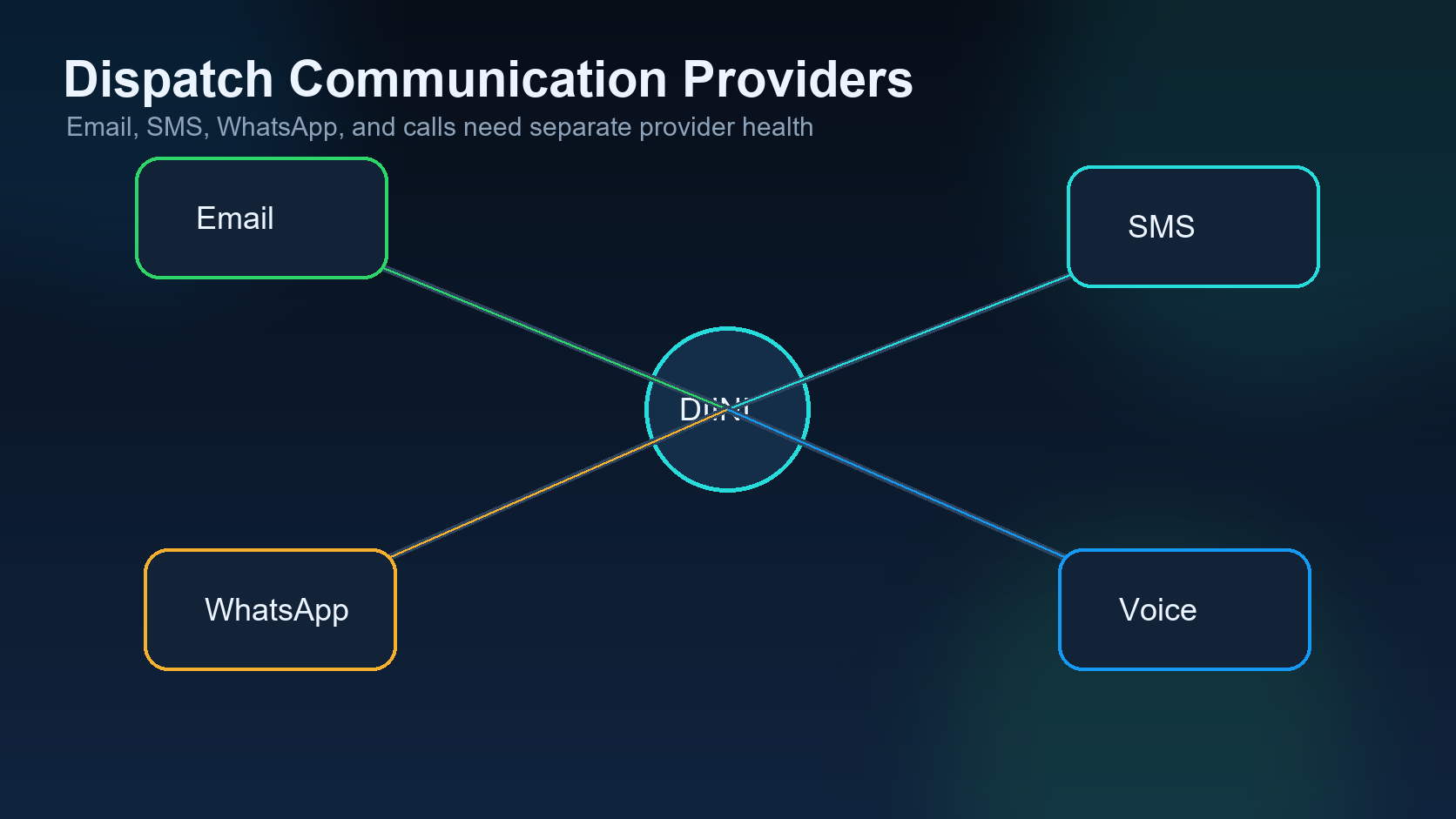
Communication providers are the layer that connects a dispatch system to the real world. A dispatcher can have a clean load, a confirmed driver, a released packet, and a ready invoice workflow, but the operation still depends on messages reaching the right people at the right time.
Previous article in the series: POD to Invoice.
This ninth article in the DIINI AI series follows POD to Invoice. Now the focus is the communication stack: email, SMS, WhatsApp, and voice calls.
This part of production is easy to misunderstand. A workflow can be active in the software and still be blocked by a provider rule. A message can be queued but not delivered. A phone number can work for voice but still require registration for SMS. Good dispatch automation has to show those differences clearly.
1. Separate email from SMS
Email and SMS usually have different providers, rules, and failure modes. If email is connected through a provider like SMTP or a transactional email service, that does not automatically mean SMS is ready.
2. Treat SMS compliance as part of production
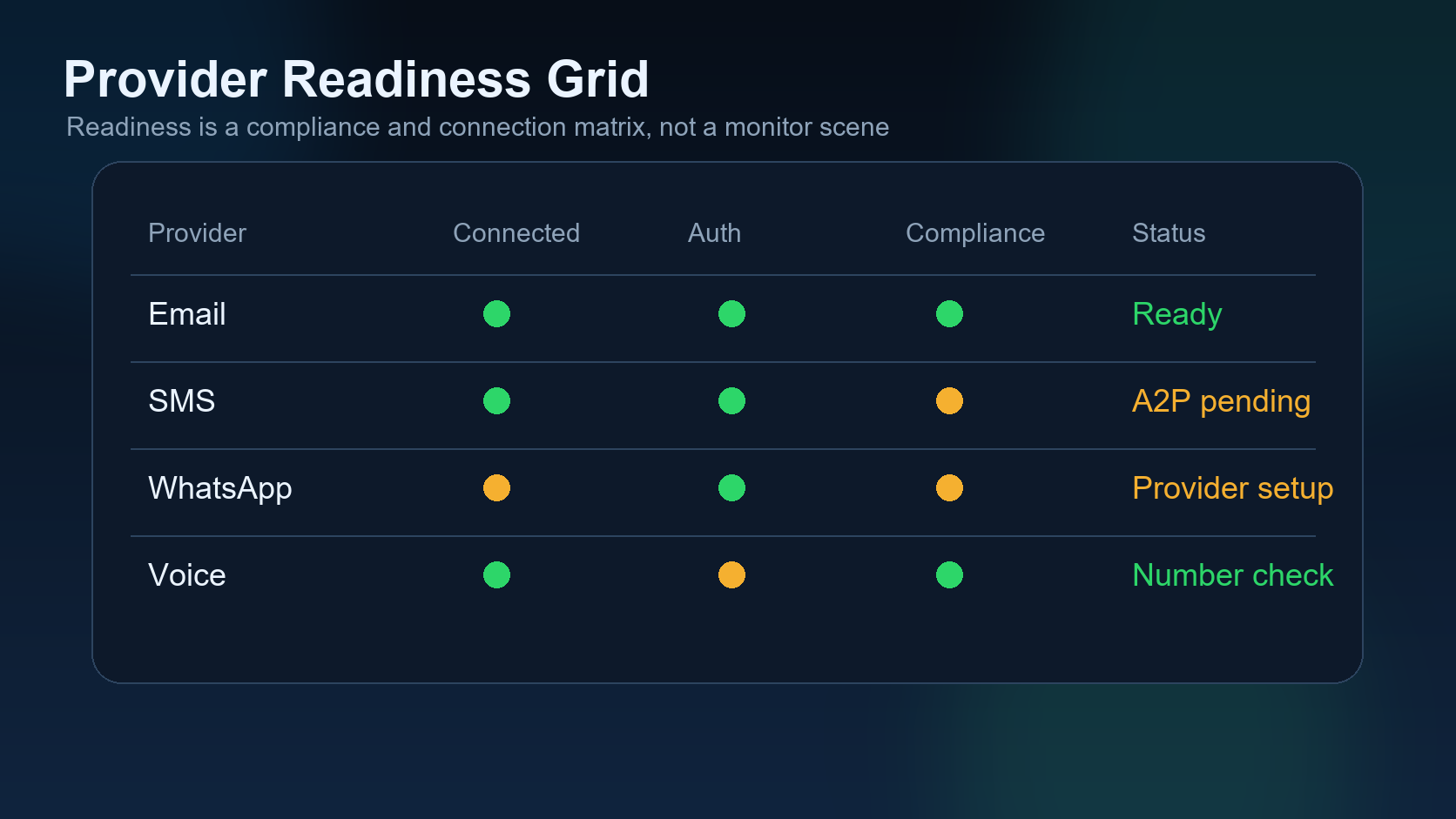
In the United States, business SMS often requires registration and approval. If that registration is rejected or incomplete, the code may be fine while delivery remains blocked. The dashboard should show that as provider setup, not as a mysterious app failure.
3. Understand WhatsApp separately
WhatsApp may use a sandbox during testing or an approved sender in production. It should be tracked separately from normal SMS because the approval path and recipient requirements can be different.
4. Test voice calling on its own
Voice calling may depend on a phone number connected to a calling provider. A number can be valid for calls even when SMS registration still needs work. Production testing should verify call placement, answer behavior, and logs separately.
5. Record message status
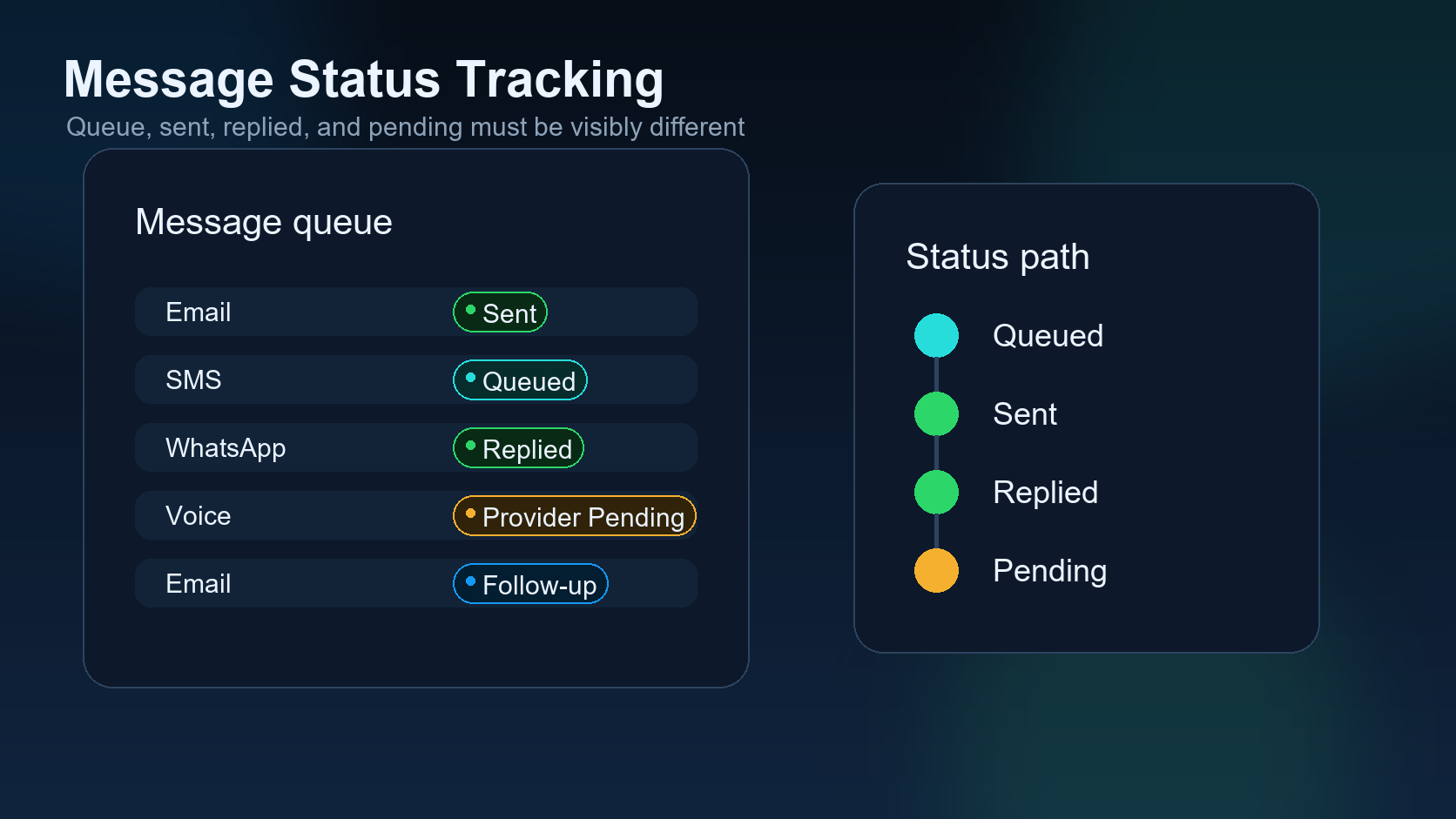
A dispatch system should not only say “sent.” It should track queued, sent, replied, failed, and provider pending states. That is how a dispatcher knows whether to wait, retry, or call manually.
6. Keep human approval for sensitive sends
AI can draft a broker update or driver message, but the system should be careful with messages that affect money, service failure, or legal responsibility. A human approval step protects the operation.
7. Make provider readiness visible
The best dashboard does not hide provider status. It shows email connected, SMS pending registration, WhatsApp sandbox, or voice ready. That saves hours of guessing when a message does not behave as expected.
The production lesson
Communication is not just a feature. It is a provider ecosystem. To make AI dispatch reliable, carriers need clear status, careful testing, and a workflow that never confuses queued with delivered.
Together, these workflow articles show the practical path from load evaluation to driver assignment, dispatch release, lifecycle tracking, billing, and communication readiness. That is where AI becomes useful: not as noise, but as controlled operational support.
Field example: one message should not go through every channel
A pickup reminder may work well by SMS. A document request may be better by email. A fast delay escalation might need WhatsApp or a direct call. The provider choice should depend on urgency, proof needed, driver preference, and compliance rules. Dispatch communication providers are not just technical integrations; they shape whether the right person receives the right message at the right time.
A production dispatch system should choose the channel intentionally instead of blasting the same message everywhere.
Provider decision table
| Channel | Best use | Watch out for |
|---|---|---|
| Documents, invoices, broker records. | Slow response when urgency is high. | |
| SMS | Short driver reminders and confirmations. | Compliance, opt-in, and number registration. |
| Driver-friendly updates and images where allowed. | Provider rules and availability by user. | |
| Calls | Urgent exceptions, safety issues, complex negotiation. | Needs clear logging and follow-up notes. |
Common mistake
Do not connect every provider before defining message rules. Start with the messages that matter most: driver YES confirmation, pickup ETA, delay alert, POD request, and payment follow-up.
Related DIINI reading
Dispatcher takeaway: provider setup should follow the workflow
The best provider is not always the most popular provider. The right setup depends on what the dispatch team needs to send, who needs to receive it, and what proof must be kept. Email is strong for documents. SMS is strong for short driver prompts. Calls are strong for urgent exceptions. WhatsApp can be useful where drivers already prefer it. The workflow should decide the channel, not the other way around.
Mini FAQ
Should a dispatch company connect SMS before email? Usually no. Email is needed for documents, invoices, broker records, and formal communication. SMS can come next for driver confirmations and quick status prompts.
Why does compliance matter for SMS? SMS providers may require proper registration, opt-in, and message rules. Without that, messages can fail or the account can be limited.