


AI agents in truck dispatch are often described as if they were the same thing as ordinary automation or a chatbot. They are not. Automation follows a defined process, AI interprets information, and an AI agent coordinates tools and actions toward a goal.
That distinction matters in trucking. A system that sends a reminder is useful automation. A system that evaluates a load is using AI. A system that gathers the load data, asks the negotiation brain for a strategy, prepares a broker response, monitors the driver, and starts billing after delivery is acting more like an agent.
This second article in the DIINI AI series explains how the three layers work together across a complete dispatch workflow, without giving software authority it should not have.
The three operating layers
A dependable dispatch platform separates responsibilities instead of calling every feature “AI.” Each layer should have a clear job, known inputs, and a limit on what it can do.
| Layer | Main job | Dispatch example |
|---|---|---|
| Automation | Repeat a known process | Create an invoice draft after a signed POD arrives |
| Artificial intelligence | Interpret and recommend | Score a load using RPM, deadhead, cost, equipment, and risk |
| AI agent | Coordinate tools and next actions | Move an approved load from evaluation through delivery and billing |
The layers are strongest when they remain separate. A conversation model should not calculate the carrier’s minimum rate. A workflow engine should not invent missing broker information. An agent should not approve its own high-risk decision.
What dispatch automation does well
For AI agents in truck dispatch, automation is best for tasks with a predictable trigger and outcome. It reduces forgotten steps and keeps records consistent across dispatchers, drivers, and tenants.
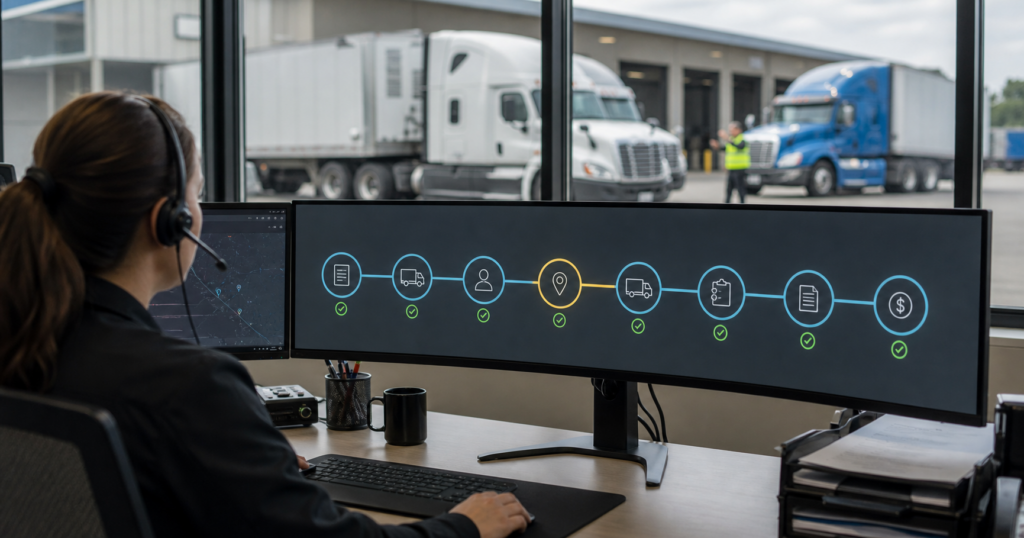
Useful examples include creating a load record from a submitted form, assigning a due date to an invoice, scheduling 30-, 45-, and 60-day collection reminders, logging a sent message, or changing a driver from Assigned to At Pickup after an approved status update.
Automation is reliable because its boundaries are visible. If the required POD is missing, the invoice workflow should stop. If a tenant’s plan does not include a feature, the gateway should block it. The workflow does not need to “think” about those rules.
What artificial intelligence adds
AI agents in truck dispatch need intelligence when the system must interpret several signals rather than follow one fixed instruction. In truck dispatch, the useful output is usually a score, recommendation, classification, extracted fact, or communication draft.
For example, AI may compare a $3,200 reefer load against trip miles, deadhead, fuel estimate, delivery schedule, broker history, and the carrier’s minimum. It can explain why the load is Best, Good, or Avoid. The dispatcher receives a reasoned recommendation rather than a mysterious score.
AI can also draft a broker message, summarize a rate confirmation, identify a missing accessorial term, or flag a POD that appears unreadable. These are interpretation tasks. They still require verified source data and a safety layer.
What an AI agent actually does
An AI agent coordinates several approved capabilities to pursue an operational goal. It observes the current state, chooses the next permitted action, calls the correct module, records the result, and stops when approval or new information is required.
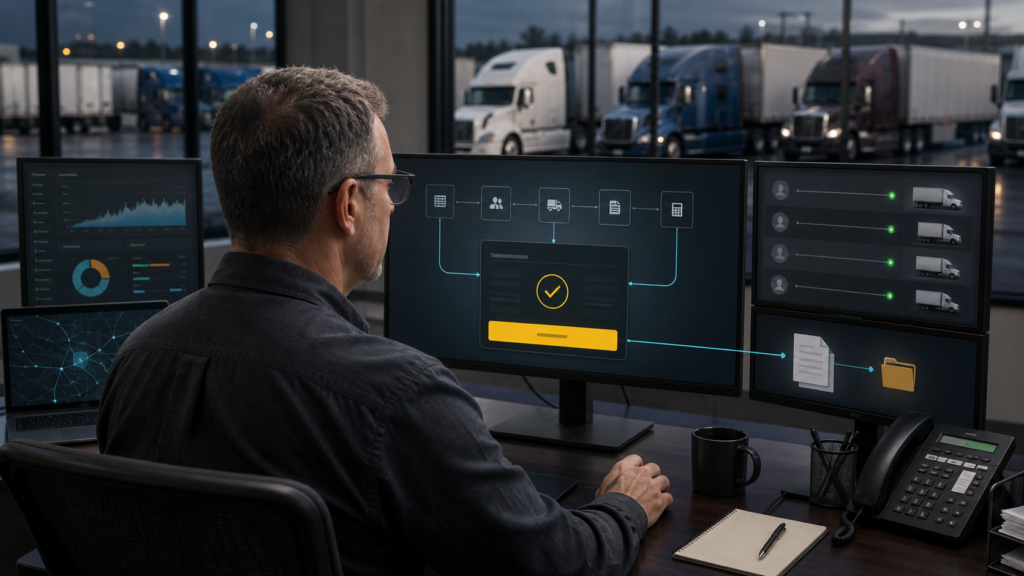
In DIINI, the AI Commander is designed to coordinate existing modules. The Negotiation Brain controls price strategy. The Safety Checker enforces minimums and permissions. Conversation AI only communicates the approved decision. Human Approval controls binding acceptance and uncertain cases.
This modular structure is safer than one large agent with access to everything. It creates an audit trail showing what information was used, which module made the decision, what action followed, and who approved it.
Seven proven roles for AI agents in truck dispatch
1. Organize load intake
The agent can collect manually entered load details, normalize equipment and location fields, calculate RPM, and identify missing data. It should never silently invent a rate, MC number, pickup appointment, or cargo requirement.
2. Coordinate load scoring
The agent can send verified data to the scoring module, compare the result with carrier preferences, and place the load in a ranked queue. A low-confidence or high-risk result should be routed to a dispatcher.
3. Prepare negotiation actions
AI agents in truck dispatch can ask the Negotiation Brain for an opening ask, target, and walk-away rate. Conversation AI can then prepare the email or message. The protected minimum remains immutable, and binding acceptance stays with an authorized human.
4. Coordinate driver assignment
The agent can compare truck location, equipment, availability, and recorded preferences before recommending a driver. HOS, license, insurance, and real-world readiness must be confirmed from authoritative data or by operations staff.
5. Monitor execution and exceptions
The agent can watch status events for At Pickup, Loaded, In Transit, At Delivery, and Delivered. Missing updates, late arrivals, detention risk, and document gaps can create alerts and draft broker communication.
6. Collect delivery documents
After delivery, the agent can request the signed POD, detect whether a file was uploaded, and send it for readability review. A person should confirm signatures, amounts, and dispute-sensitive evidence.
7. Start billing and follow-up
Once the POD is approved, the agent can prepare an invoice, set the due date, and place reminders in the collection queue. Actual payment receipt, factoring disputes, credits, and final account closure require verified financial information.
Where human approval remains mandatory
The autonomy of AI agents in truck dispatch should be based on risk, not marketing language. Low-risk clerical actions may run automatically. Commercial commitments, safety decisions, legal claims, and payments need stronger controls.
- Accepting a broker’s final rate
- Operating below the carrier’s protected minimum
- Using broker or carrier data that cannot be verified
- Confirming HOS, authority, insurance, or driver compliance
- Submitting detention, TONU, layover, or damage claims
- Resolving invoice disputes or marking money as received
- Overriding tenant permissions or plan limits
The NIST AI Risk Management Framework is a useful public reference for thinking about reliability, transparency, accountability, and human oversight in AI systems.
How to evaluate a dispatch agent
A demo of AI agents in truck dispatch can look impressive while hiding weak controls. Evaluate AI agents in truck dispatch with measurable questions:
- Does every action use verified tenant-scoped data?
- Can the system explain the recommendation and confidence?
- Are protected minimums and permissions enforced outside the conversation model?
- Does the agent stop when required information is missing?
- Are outcomes and human feedback recorded for later evaluation?
- Can an administrator audit who did what and when?
- Can the workflow recover safely after a provider failure?
The first article in this series explains the practical benefits and safety limits of AI truck dispatch. The DIINI platform overview shows how loads, drivers, negotiations, documents, invoices, and reporting fit into one operating environment.
What comes next
The next article will examine AI load scoring in detail: RPM, deadhead, weight, equipment compatibility, operating cost, broker risk, confidence, and the difference between a useful score and false precision.
The purpose of an AI agent is not to imitate a dispatcher. It is to coordinate dependable tools, surface the right decision, complete approved work, and bring the human back in exactly when judgment and accountability matter.
Continue the AI Dispatch Series
This article is part of the Diini Dispatch AI series for carriers, brokers, and dispatch teams that want safer load decisions, clearer driver communication, and a more automated dispatch workflow.
Previous in the series: AI truck dispatch
Next in the series: AI load evaluation
Related guides
- AI Truck Dispatch: 7 Proven Benefits for Carriers — Part 1 — why AI dispatch matters for carriers
- AI Load Evaluation: 7 Checks Before You Book a Load — Part 3 — how loads are checked before booking
- AI Driver Assignment: 7 Proven Checks Before You Send a Load Offer — Part 4 — how the right driver is matched to the load
Want to see the workflow in action? Visit the Diini Dispatch AI workspace or contact Diini Dispatch AI to request access.
Real workflow example: AI agent roles during a live load
A useful dispatch agent does not need to do everything. One agent can watch load fit, another can draft broker questions, another can monitor missing documents, and another can prepare invoice follow-up after delivery. This separation matters because dispatch work changes by stage. The same logic that helps before booking is not the same logic needed when a driver is waiting at pickup or when accounting needs a clean POD.
For example, before booking, the system should ask about rate, lane, pickup time, delivery time, and driver fit. After booking, it should watch packet release, driver confirmation, pickup status, delay risk, delivery confirmation, POD, and invoice creation. That is how AI agents become operational support instead of a chatbot sitting on the side.
Agent responsibility map
| Agent role | Primary signal | Escalates when |
|---|---|---|
| Load evaluator | Rate, miles, timing, broker notes | The load does not fit driver hours or lane plan. |
| Driver coordinator | YES confirmation, ETA, pickup status | The driver is late, silent, or missing documents. |
| Document watcher | Rate con, BOL, POD, invoice packet | A required file is missing or unreadable. |
| Payment follow-up | Invoice status and aging | A payment promise or due date is missed. |
FAQ
Should every dispatch task become an AI agent? No. Start with repeatable checks that have clear inputs and a clear human approval point.